The Math Behind 2048 Cupcakes: Understanding the Grid System
2048 Cupcakes looks like a simple, sugary reskin of a classic puzzle game, but underneath the colorful frosting sits a surprisingly elegant piece of mathematics. Every swipe you make is governed by a strict set of grid rules, probability calculations, and exponential growth patterns. If you’ve ever wondered why the board fills up faster than expected, why certain cupcakes seem rarer than others, or why top players always seem to plan three moves ahead, the answer lies in the math powering the grid.
This article breaks down exactly how the 2048 Cupcakes grid system works, the number theory behind merging, and how understanding this math can help you build a smarter, more consistent strategy toward the legendary Rainbow Cupcake. Put the theory into practice by playing 2048 Cupcakes directly in your browser.
How the 2048 Cupcakes Grid Is Structured
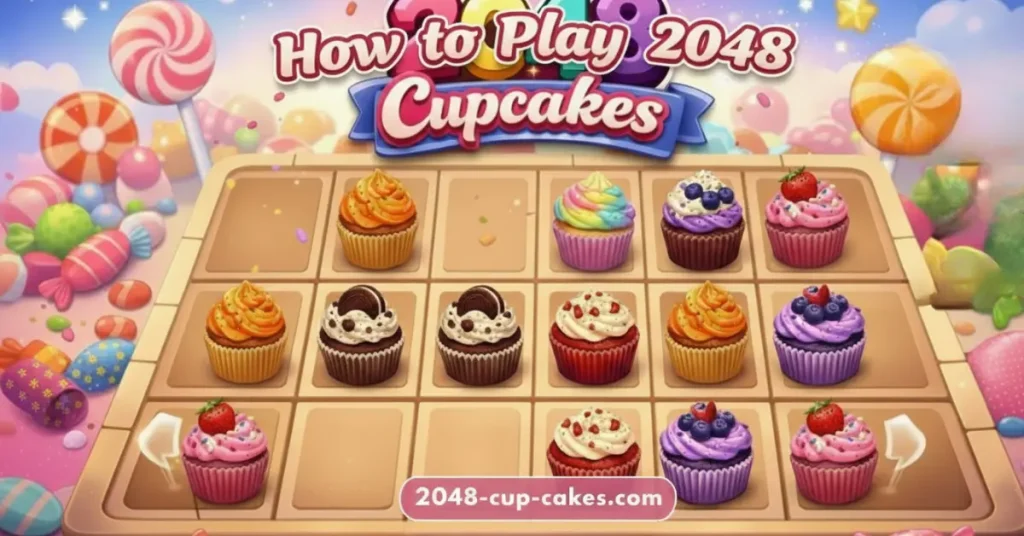
At its core, 2048 Cupcakes runs on a fixed 4×4 grid, giving players sixteen total cells to work with. This grid size isn’t arbitrary it’s the same structure used in the original 2048 puzzle created by Gabriele Cirulli, and it’s mathematically balanced to be small enough to fill quickly, yet large enough to allow strategic maneuvering.
Why a 4x4 Grid and Not Something Bigger
A 4×4 grid creates just enough tension between space and opportunity. With only sixteen cells, every new cupcake that spawns meaningfully impacts your available moves. Larger grids (like 5×5 or 6×6) would make the game far too easy, since players would have significantly more room to organize cupcakes before running out of moves. Smaller grids would make the game nearly unplayable, since merges would run out of space almost immediately.
Row and Column Mechanics
Each swipe direction up, down, left, or right shifts every cupcake in that direction as far as it can go, merging matching cupcakes along the way. Mathematically, this is a compression function: the grid removes empty gaps in each row or column and merges adjacent equal values before repositioning the rest. This is why planning your swipes matters more than swiping randomly each move recalculates the entire board state at once, not one tile at a time.
The Doubling Pattern Behind Cupcake Values
The heart of 2048 Cupcakes’ math is exponential doubling, the same concept that powers the original numbered version of the game.
Understanding Exponential Growth in the Grid
Every cupcake value doubles when two identical cupcakes merge. Starting from the lowest tier, Vanilla Birthday (200 Kcal), each successful merge produces the next value in the sequence: 200 → 250 → 320 → 400 → 500 → 650 → 820 → 1000 → 1200 → 1500 → 3000 → 5000. While the numbers aren’t a perfectly clean mathematical doubling (since the calorie theme adjusts values for flavor and pacing), the underlying logic mirrors exponential growth: each new cupcake requires roughly twice the effort of the one before it.
This is why reaching the Rainbow Cupcake becomes dramatically harder the closer you get. Early merges happen constantly, but higher-tier cupcakes require increasingly larger chains of smaller merges stacked beneath them.
Why Late-Game Merges Feel Slower
From a probability standpoint, higher-value cupcakes require exponentially more successful low-tier merges to produce. If it takes two Vanilla Birthdays to make one Bubblegum Pink, it takes four Vanilla Birthdays to make one Sunshine Vanilla, eight to make one Valrhona Blond Ganache, and so on. By the time you’re chasing the Rainbow Cupcake, you’re mathematically relying on dozens of earlier merges happening in the correct order and position — which is why late-game boards feel so much more difficult to manage.
The Role of Randomness in Cupcake Spawning
While merging follows strict doubling logic, new cupcake spawns are governed by weighted randomness, another key mathematical layer in the game.
Weighted Probability for New Tiles
After every swipe, a new cupcake spawns in a random empty cell. Just like the original 2048 game (where new tiles are usually a 2 with occasional 4s), 2048 Cupcakes spawns lower-tier cupcakes far more frequently than higher-tier ones. This weighted probability keeps the board balanced if high-value cupcakes spawned as often as low-value ones, the game would become either too easy or completely unplayable within a few moves.
Why This Matters for Strategy
Because low-value cupcake spawns are statistically more common, skilled players build their strategy around predictable probability rather than luck. Since you can reasonably expect a steady stream of small cupcakes, the smartest approach is to control where they land relative to your larger cupcakes, rather than hoping for rare high-value spawns to save your board.
Once you understand the powers of two, our 2048 Cupcakes cheats make a lot more sense.
The Corner Strategy Explained Mathematically
One of the most recommended techniques for 2048 Cupcakes is the corner strategy, and it holds up under mathematical scrutiny.
Why Corners Minimize Risk
Placing your highest-value cupcake in a corner mathematically reduces the number of directions it can be disturbed from. A cupcake in the middle of the grid can be affected by merges from up to four directions, while a corner cupcake is only vulnerable to two. This dramatically lowers the probability of accidentally shifting your most valuable cupcake out of position.
Building a Gradient Across the Grid
Advanced players extend the corner strategy into a full gradient pattern, arranging cupcakes in a descending order of value across one row or column. This creates a predictable, chainable merge path, since each swipe reinforces the same directional flow instead of scattering values unpredictably across the grid. Mathematically, this reduces the entropy (disorder) of the board, keeping merges efficient and consistent.
The corner strategy explained here is the base of our guide on how to win 2048 Cupcakes.
Calculating Your Odds of Reaching the Rainbow Cupcake
Reaching the Rainbow Cupcake (5000 Kcal) requires a specific number of successful merges layered on top of each other.
Merge Count Required
To build one Rainbow Cupcake from scratch, you theoretically need a chain of merges stacking all the way from Vanilla Birthday up through every tier. Since each tier requires two of the previous tier, reaching the final cupcake mathematically requires thousands of individual low-tier merges across an entire play session, assuming no space is wasted.
Why Board Space Efficiency Is a Math Problem
With only sixteen cells available, every wasted cupcake placement reduces your mathematical ceiling for how high you can build. This is why efficient players rarely let more than one or two “stray” low-value cupcakes sit unmerged for long every unmerged cupcake occupies space that could otherwise be used to build toward higher tiers.
The grid rules stay the same in both versions, as shown in 2048 Cupcakes vs classic 2048.
How Understanding the Math Improves Your Strategy
Once you recognize the mathematical patterns behind 2048 Cupcakes, your decision-making shifts from reactive to predictive.
Predicting Board States in Advance
Because merges follow strict, deterministic rules, skilled players can often predict what the board will look like several moves ahead. This is similar to how chess players calculate future positions except here, you’re calculating merge chains and empty-cell probability instead of piece movement.
Reducing Random Loss Through Controlled Play
Since spawn locations are the only truly random element in the game, minimizing your exposure to randomness (by keeping your grid organized and predictable) is the most reliable way to improve your results. This is why the corner strategy, gradient building, and limited directional swiping are so consistently recommended they all reduce the game’s random variables while maximizing the mathematically deterministic ones.
Grid efficiency is exactly what separates average runs from the highest score in 2048 Cupcakes.
Frequently Asked Questions
Is 2048 Cupcakes Based on Real Mathematical Formulas?
Yes. The game’s merging system directly mirrors exponential growth and probability weighting, both of which are foundational concepts in mathematics and computer science.
Does Grid Size Affect Difficulty Mathematically?
Absolutely. A larger grid would exponentially increase the number of possible board states, making the game easier, while a smaller grid would restrict merge opportunities and increase difficulty.
Why Do Higher-Tier Cupcakes Feel Rarer?
Because of weighted spawn probability and the exponential number of merges required to reach them, higher-tier cupcakes are mathematically rarer by design, not by random chance alone.
Top players use these merge patterns to chase the 2048 Cupcakes world record.
Final Thoughts
What feels like a lighthearted dessert-themed puzzle is, underneath the surface, a carefully balanced mathematical system built on grid compression, exponential doubling, and weighted probability. Understanding these mechanics doesn’t just satisfy curiosity it directly improves how you play. By recognizing how merges, spawns, and grid space interact mathematically, you can approach every swipe with a clearer strategy, steadily working your way toward unlocking the ultimate Rainbow Cupcake.